| |
MNX2010 PC Audio Sites - Update :
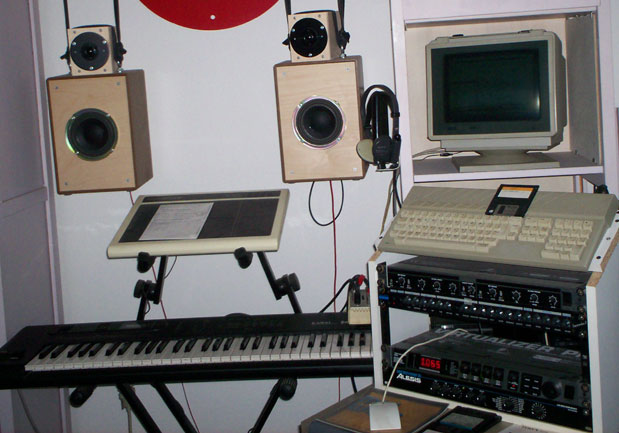 Atari Studio
In 2011, I started transforming my Atari Studio, which I had been using for about 12 years, into a PC studio. Converting all the files was a lot of work, but eventually, with the right software, I was able to convert them all. For converting Cubase arrangements, I used one of the first Cubase (GS) PC versions to make it more PC-compatible. Saved in GS, it can be read by Cubase SX and Cubase 5 and later versions. For the sound banks for my synthesizers, I converted the Atari editor banks to the PC sound bank editor. In practice, this means: storing (saving) the Atari sound bank in the synthesizer and then storing it back in Sounddiver and Midi Quest XL. It's a lot of work, but it also allows you to really get to know the software's capabilities. It not only makes it much more complex but also offers more possibilities for setting up a professional studio. Fortunately, I have the necessary experience setting up a studio and had saved up for it. In preparation, I looked far and wide for equipment to purchase. Ultimately, I replaced almost everything except the Kawai K4, TX81, the analog Braintec, and my 24-inch mixer. The wiring was quite expensive and labor-intensive, especially if you're looking for quality. Therefore, I made all my own wiring with high-quality wiring and connectors. Generally, the possibilities with a PC are much more extensive, but I miss certain features in modern Cubase, such as the part parameters in Atari Cubase. I also miss the sound editors I'd collected for my Atari; generally, the PC editors are rather disappointing, especially if you're used to Atari. That's why I'm keeping my Atari computer for a while. … MNX2010 (Jan 2011)
For more info >>> Atari-Music & Kawai K4
 PC Studio
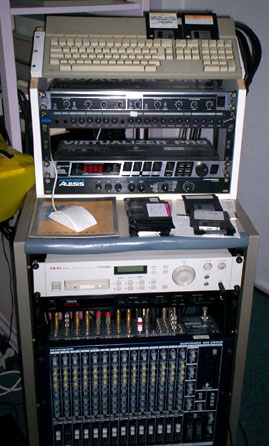
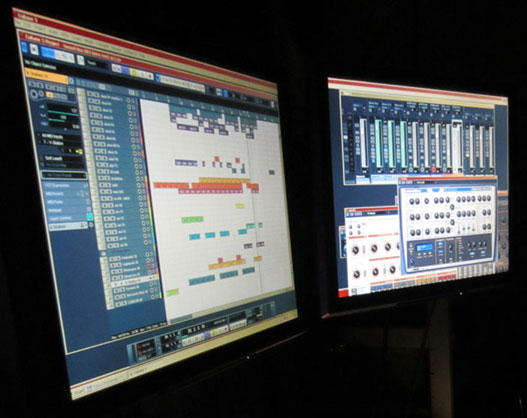
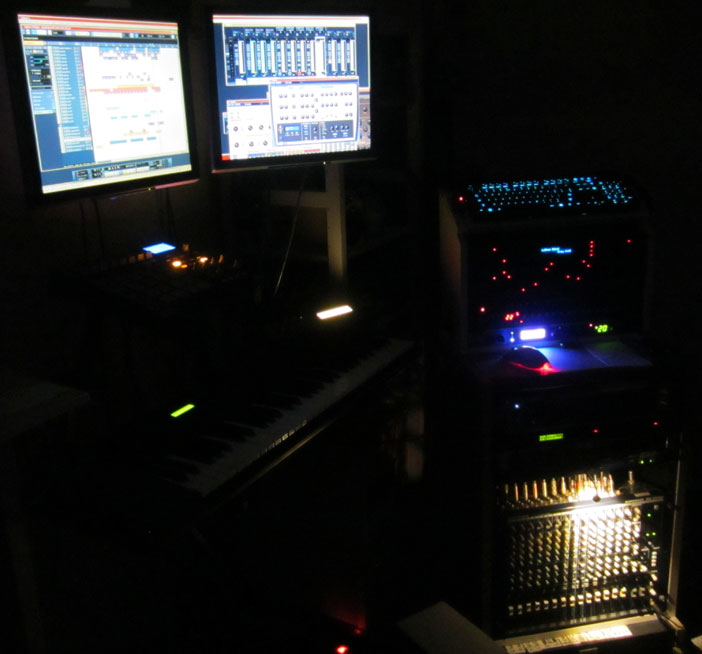
My plan was initially quite simple: a few real analog synthesizers, a virtual analog synthesizer, a digital FM & AM synthesizer, a sampler, a multi-channel sound card, and a professional effect. I wanted to run XP on the computer, as most music software and editors are most compatible with it. A dual-monitor graphics card was needed to manage the many windows within Cubase. Arrangement in the left window and key editing, mixer, and VST instruments in the right. A MIDI controller—I currently have the Akai MPD-32. In practice, it's not that simple. Often, when you buy something secondhand, "there's often something wrong with it," especially if it's sought-after and popular equipment. So you have to be technically minded and have good analytical skills. New, on sale, is better than secondhand. For example, I got my effect 150 euros cheaper, which saves a lot, and you also have a warranty. Ultimately, it's important to create a good foundation and expand from there.
Info Music Productions >>> Energetic Vortex
Soundcard
But a real problem I've encountered with secondhand devices is that you're not guaranteed the correct drivers. Since updates often don't work properly or poorly, you need to be able to rely on the original drivers. Usually, when you buy a secondhand device, there's no driver CD included; most people throw those away. Usually, that "original driver CD" can be found on the service site, but as in the case of my Motu MK1, I did eventually find the original driver CD, but not on the original download page, and it didn't even say it was suitable for XP. It was a driver from the time the device was manufactured, and I tried it and it worked. In the driver's text file, I found that it was indeed the original driver CD, also suitable for XP, but the content had to be installed from the CD; otherwise, certain components wouldn't install. Apparently, Motu is doing its best to hide the correct driver software, and I encountered the same issue with the EMU 1212M. After a long search and trial and error, I found the correct driver that also supports the optical ADAT channels. The reason is clear: it's in their own interest to provide shoddy service. This way, they sell more new equipment, and a lot of old equipment that still works perfectly well is discarded this way. Most people don't have the knowledge or patience to get to the bottom of things like I did. An important lesson: never buy a sound card/module without the original driver CD!
The most important thing for me is the sound, and as far as I know, Motu and RME are the best, so it's a matter of money. RME is more than twice as expensive, but definitely "the best." The choice of a multichannel audio card ultimately depends on what you want to do with it, how many channels you want, and any plans for potential expansion. Optical ADAT can be a good solution, although an ADAT module is relatively expensive. The connection from the module to the PC is also important in the choice. In retrospect, it wasn't wise to buy a Firewire module for a PC; you're better off with an Apple Mac. They have standard Firewire 400 and 800; the PC has several (PCI and PCI-e), which means the drivers for the modules don't work or work poorly. A module with a USB port that you can plug into anywhere is better. Convenient, but too slow. You need a USB 3.0 port for a multichannel module with low latency. This is due to the use of multiple channels simultaneously. There are a lot of complaints on forums about multichannel audio cards. I've had my own experience: last year, a TerraTec Phase 88 suddenly broke. I had installed the original CD on a clean XP system but couldn't get it to work, but the MIDI still worked. What are you supposed to do with that? Those multichannel cards are quite expensive, so it's a big blow if they break. If I had to buy a new one right now, I wouldn't know what to buy, maybe a Motu 828 MKII or MKIII. The Motu 828 MKII looks sleek, has good sound, low latency, and offers many expansion options. You can get one used for around 250 euros. RME remains my favorite, but I'll have to save up a bit more... MNX2010 (June 2016)
Analog and Digitale Studio
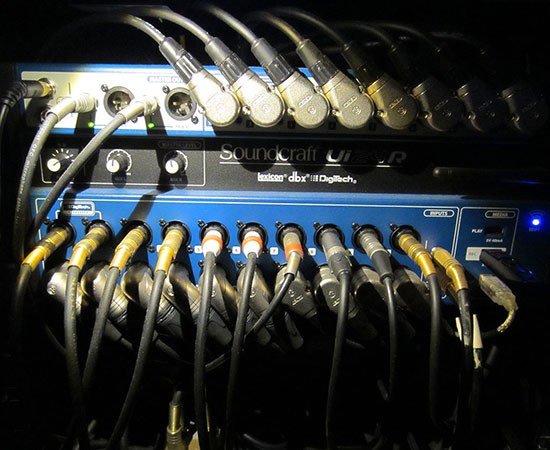
My idea was to work with both hardware and software synthesizers, but along the way I discovered that real analog synthesizers sound much better. So I came up with the idea to try a different approach. So more analog hardware and because I'm a fan of acid music, I started looking into TB-303 clones. The top is the TB-303 itself, with standard no midi and nowadays, way too expensive! So first I bought an XOXBOX Andy Pledger Built edition, nice sound. An MB33 MKII, a 303 clone (doubtful) but fully midi controller controllable. I already had a braintec, so I re-tuned it to the MB33, together for the baseline. For the drums I bought the jomox airbase99. It is fully controllable in real-time, which is actually what I was looking for. And a new mixing console, preferably with many options and high quality. That turned out to be the Soundcraft ui24r, a piece of technology equal to a real studio and inexpensive. I still had a 17% discount coupon, and it was on sale! Now I can shape and manipulate the sound to bring out the best. The learning curve was quite difficult at first, but with the help of YouTube and the manual, I'm making good progress. I kept the Lexicon MX400 and MX200, which offer that extra bit of space. The Korg Minilogue provides that bit of analog space with plenty of delay. The K4 was my first synthesizer and has proven to be a good addition. As has my Supernova II Rack, although I might swap that for a proper analog rack. The sampler is an Akai Z8, which remains the best sampler ever, although it's a lot of work to properly adjust the filters and effects. I also bought a Jomox Mbase 11 and a TD-3-AM to complete my studio… MNX2010 (Jan 2020)

Acid Lab
Actually, development never stands still, although I do sometimes notice that growth has stalled a bit. And so, change is in the air again. I even sold two synthesizers, the TT and the MB33, simply because their sound doesn't even come close to a TB-303. That's why I bought an RE-303, a one-to-one replica, so 100% TB. Because I needed rare Japanese "rare parts" for the RE-303, I gained some insight into the internal electronics that way. The TT and MB33 don't have these TB electronics, so it was time for me to sell them. An Avalon is still on my list, but they've been out of production for a long time and I've rarely seen them, or they're ridiculously expensive, but you never know. I also had the Supernova II Rack repaired by a friend of mine by replacing a super small audio (AD-DA converter) chip. We've also fitted the TEEBEE and RE-303 with new (rare components) 2SA733AP (NEC) transistors, which brings the sound closer to an original TB-303. Now that everything is working properly, the next step is fine-tuning. I'm starting to get the hang of the Soundcraft ui24r, which I need to master the mixing itself. It remains difficult work, as I often don't know how to get it working, which means a lot of searching online. I do the final mastering either in Wavelab with, for example, the Ozone plugin, or in the Soundcraft ui24r itself, which also works well. … MNX (April 2023)
TR-909 & TB-303 replica
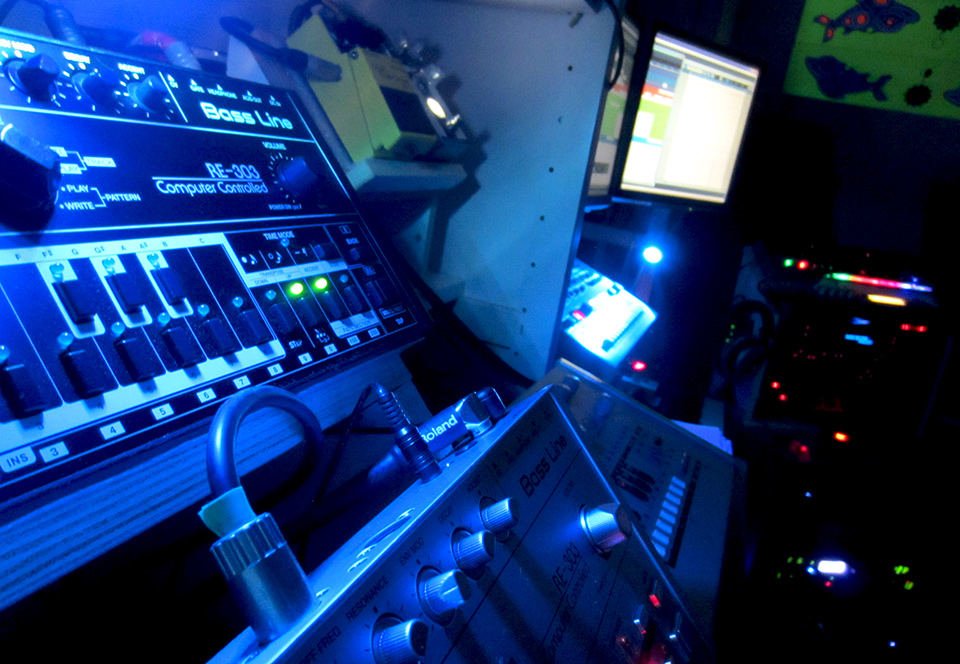
Still not entirely satisfied with the sound of my Silverbox RE-303, I contacted sonicmechanix.nl via Marktplaats. They immediately spotted what was wrong with it when I opened the cabinet. Roughly in the middle, there should have been two large flat capacitors, not two small ones, which is also what the value indicates. A trivial task, but finally that 303 sound; it sounds good in my studio too. The dynamics of the sound really blew me away. So I immediately bought another one from him: a black RE-303 with green LEDs; it's powerful, especially in the bass and low end. While the silver one I already had is more of a lead 303 and has a "singing" sound. According to sonicmechanix, they all sound different, which is part of the beauty of it. Several mods have also been added to the RE-303s: the Blackbox: CV to filter (cutoff) and the Silverbox: MIDI to filter (cutoff). The black one also has an experimental knob “Res max adjust”, which turns the resonance completely upside down, a little bit turned out to be effective, especially in the bass.

I found several nice videos on YouTube that help me get started, but I'm also reading the manuals carefully. It's actually not too bad, but it's missing a MIDI note output. The sinc-out is passed through, but the notes aren't, so you can't record them. Which is a big loss, because I love working with MIDI; you can store everything there. Besides that, a whole new world has opened up for me; it immediately sounds spacious, no matter what you're doing. To complete the picture, I also bought an RE-909, also from sonicmechanix.nl. The RE-909 already had a mod, the P4L mod (module), which allows you to change the kick, hi-hats, and claps. But I'll probably have to consider a new hardware firmware version 5.0, although it's expensive. That would fix a lot of teething problems, and it would work like a reliable, modern drum machine. Just think, MIDI was still in its infancy back then; in fact, it was the beginning. But it does complete the Studio. There are also several manual videos for the 909, and I've also printed the manual for the TR-909 and the 5.0 firmware. I can already work with it just fine. Although I do expect problems with the Sinc without the 5.0 firmware update, so I'm currently using the RE-909 as a MIDI module, and the sound is fantastic! It's a bit of a keystone, so the studio part is almost finished. Although I'd really like more control over my external effects, that's still a headache for me. I'm also working on converting my junk room into a permanent studio space. A mess in the corner, a cloth, and I'm done!
… MNX (November 2025)
Info 909 & 303 replica >>> Acid Techno
************************************************************************************************************************************
List Studio Devices
-----------------------------------------------------------------

hardware synthesizers

Akai Z8 (24bit sampler) info >>> Akai Z8
Supernova II Rack (virtual analog) info >>> Supernova II
Syntecno TeeBee Mark II (303 clone analog) info >>> Syntecno TeeBee
XOXBOX Andy Pledger Built edition (303 clone analog) info >>> XOXBOX
Din Sync RE-303 Bass Line blackbox (TB-303 replica analog) info >>> RE-303 Bass Line
Din Sync RE-303 Bass Line zilverbox (TB-303 replica analog) info >>> RE-303 Bass Line
Din Sync RE-909 Drumcomputer (TR-909 replica analog) info >>> RE-909 Drumcomputer
Braintec Transistor Bass 3 (303 clone analog) info >>> Transistor Bass 3
Kawai K4 (digital AM) info >>> Kawai K4
Jomox Airbase99 Rack (909 Clone analog) info >>> Airbase99
Jomox Jomox Mbase 11 (909 kick Clone analog) info >>> Mbase 11

-----------------------------------------------------------------

Peripherals

Soundcraft ui24r (22in-10out digitaal mengpaneel) info >>> ui24r
Steinberg Midex USB (8 chl i/o midi interface) info >>> Midex 8
Akai LPD8 (midi controller) info >>> Akai LPD8
Beyerdynamic DT 880 Pro (headphone) info >>> DT 880 Pro
Adam Audio A7V (studio monitors) info >>> Adam A7V
Samsung Syncmaster 930BF (scherm 2x)
Samsung Syncmaster XL2370 (full HD)
Computer quadcore 3Ghz (Windows 7)
Computer Samsung labtop (Windows 10)

-----------------------------------------------------------------

Effects

Lexicon MX400 (4 chl i/o surround delay) info >>> MX400
Lexicon MX200 (2 chl i/o stereo delay) info >>> MX200
Deluxe Bass (EH) - Big Muff info >>> Big Muff Pi
Dtronics Overdrive info >>> DT-303
MXR - Distortion + info >>> Distortion +
Egodriver Distortion info >>> Egodriver
Boss Flanger BF-3 info >>> BF-3
Boss Overdrive SD-1w info >>> SD-1w
Boss Overdrive/Distortion OS-2 info >>> OS-2
|

 | MAIN SITE | DJ MAN-X | MNX2010